Made in Lavenham

Made in Lavenham

Sunday, 30 March 2014

Hierarchy...

On the bubble bath/shampoo/baby-oil/baby-lotion lines, the ‘labeller’ would often be a carefully selected individual who had the necessary co-ordination skills to perform the task. The labelling job was quite difficult and involved precision timing if you didn’t want to get your fingers bashed by the labelling machine. There were only a few girls who were known as ‘labellers’.

One day the checker on the belt asked if I’d like to try labelling (presumably in the absence of a trained labeller at the time), so I jumped at the chance. However, the mechanical cap-tightener was the machine right behind where the labelling machines sat, and the girl on cap-tightening that day was clearly jealous that I’d been offered the job and not her. I started off well and managed to get the bottles horizontally into the labelling machine and out again (and stand them back on the belt, upright) without getting my fingers crushed, but within five minutes bottles were suddenly coming down the belt two at a time and with some of their caps unscrewed (if I hadn’t spotted them I’d have been covered with the contents as soon as the labels were stamped on). Obviously, this put me off my stride and even though I explained to the checker that it wasn’t my fault that bottles were arriving at the packing end without labels I ended up being moved to another section. That was my first, and last, time as labeller…

There was definitely a hierarchy and the poor soul on boxes was the one most likely to be at the bottom of the pecking order.

There was an elderly lady (Doris?) who did all of the cleaning / mopping up. A young, blonde girl (Daisy?) was also allocated cleaning duties at a later date.

Checkers were in charge of each belt. They wore navy overalls (the rest of us wore pale blue overalls).

Supervisors wore white coats.

There was an office with large windows overlooking the bubble bath and shampoo conveyor belts in the main hall at Riverside Works. This was where two female managers (one mature lady with curly hair and a younger woman with long, blonde hair) would oversee operations, and where you were called to if something was wrong.

Relatively few men worked in the factory, they would either be managers or would be doing all of the heavy lifting and mending.

I get the feeling that those who worked alongside old school friends and/or family members probably had a great time at the factory, especially if money wasn’t particularly an issue. However, for anyone who didn’t already know people there it might not been quite so easy. Some were lucky enough to remain in the same department throughout their employment, but others (like myself) were moved around quite a bit, making it difficult to make new close friends. Also, staff turnover was quite high so even if you did manage to make friends they often didn’t stay at the factory for long (no mobile phones or facebook back then, so keeping in touch once people left work was rarely an option unless you happened to live in the same village).

Belts...


The job of the person on ‘boxes’ was to pick up the flat-packed empty boxes and take their chances with the stapler and then put inserts (if needed) into the empty boxes. The checker and packer at the end of the belt both needed a constant supply of boxes to fill, so this was a physically demanding task. Not only that, the girl also had to take away all of the filled/sealed boxes and stack them onto a wooden pallet, as well as rush around looking for a handyman to get the full pallets taken away and a new empty pallet brought to the end of the belt ready to use. Whenever the belt had to stop for any reason for longer than a minute or so, the checker usually encouraged the other girls on the line to help make up boxes until the belt could start up again.

Fillers would place the filled bottles onto the far end of the belt, cappers would loosely screw caps on and then they’d arrive at the cap-tightener machine.The cap-tightener machine could only work at a set pace; you’d pick up a bottle with your right hand, shove it into the tightener as the twisting device came down and you’d use your left hand to place the bottle (with the tightened cap) onto the belt the other side…while picking up another bottle with your right hand, and so on…

If the bottles were small, they’d be filled much quicker and so you’d end up with far more bottles coming down the belt towards the cap-tightener, and it’d be a struggle to keep up with the pace. One day, there were two girls filling tiny bottles and the cap tightener was already at maximum speed but there was a huge backlog building up on the belt. I had to stop the belt several times just so I could clear the backlog, and although I kept telling the checker it was physically impossible to keep up with the fillers she simply told me to work faster. After about an hour of this I stopped the belt and told the checker I had a splitting headache and couldn’t carry on, and I walked off the factory floor (presumaby to a sick room, although I don’t remember one). A little later on I went back to the belt and found that they’d taken off one of the fillers (clearly, whoever took over my job also couldn’t cope with the volume). Needless to say, the checker didn’t apologise to me for giving me a hard time and not believing me…

This is a great example of the type of work done at E. R. Holloway Limited. This Pathe Newsreel shows a cosmetics factory in Surrey in 1972..http://www.britishpathe.com/video/cosmetic-factory-colour/query/Surrey

Saturday, 29 March 2014

Bubble Bath...

There were huge aluminium tanks filled with liquid (bubble bath, shampoo etc) which were brought into the main floor at Riverside Works. These were what fed the filling machines at the far end of each belt. These odd little machines were always covered in gunge from various spillages. In the backs of them were two rods which you twisted to adjust how much liquid came through (not an exact science). You could fill two bottles at a time and any overflow dripped into cream coloured bowls (looked like washing up bowls) underneath. Once full, these would be emptied into one of the nearby sinks. (I’m not entirely sure whether we were supposed to do that!)
The trick was to wait a few seconds for the bottle on the left to be half full, and then put the bottle under the right hand nozzle. When the right hand bottle was half full the left one was full and could be placed onto the belt to be capped. This involved great co-ordination, as the smaller bottles took just a few seconds to fill! You always tried to have an empty bottle in one hand and a full one in the other.
After a day of having your hands covered with chemicals, some of the girls ended up with very itchy skin. I vaguely recall that the chaps working behind the scenes with all of the chemist stuff would provide tubs of cream to alleviate the symptoms.

Machinery in the Aerosol Factory ('The Station')...

There were two separate belts, one large and one small. Buttons dotted along the length of the line allowed you to stop the entire belt if there was a problem.

The larger line had pallets of empty tins at the start, which one girl had to put onto a revolving table. The tins then travelled along a narrow belt where another girl/s would insert the valves. The tins would then go through a pressure chamber and then past a set of scales. Next they’d travel through a deep tank of hot water before they went into the ovens. Out the other end was where caps were put on by hand (and little red adapters for lighter fuel). Then the packers would put a dozen in each box before sending them down to the glue machine…. where some unfortunate girl would oversee the sticky bits and load the closed boxes onto pallets.

The smaller line was situated along the back wall and was far more cramped to work on, but had an identical set-up in regards to loading tins, inserting valves and so on.

When on the job ‘tins’ the task would be to attempt to use all 10 fingers and thumbs to pick up the tins and place them onto a turntable, or the static area adjacent to the turntable. Tall hairspray cans were a nightmare as they kept falling over, and once one went down they all fell like dominoes. Also, the tins arrived on wooden pallets, and between each layer was a large, heavy piece of cardboard. Every time you lifted a piece of cardboard off several tins would fall off the edge of the layer onto the floor and need to be picked up (as fast as you could to ensure the tins on the turntable did not run out).

The tins would rotate from the turntable along a narrow belt, where machinery would fill them. If you were clumsy when inserting the valves you could end up knocking the tins over and get the contents in your lap. Hairspray was particularly sticky when spilled. After having valves inserted the tins would pass through a protected area to be pressurised. The manager (Mr Pye) was the only person with permission to go into the pressurised area (possibly with the exception of Stephen the fitter) as this was potentially dangerous .

Out the other side, the belt took a left turn and took the tins past the girl on ‘weighing’ who would have to weigh at least one in eight tins to ensure they were not empty.

Past the weighing scales the tins would take another left turn and travel through a tank of hot, deep water. The girl on ‘tank’ would have a set of tongs, and if she spotted any air bubbles coming from any tins she would grab them out of the tank and put them into a nearby plastic tub.

Next was the hot oven, and once through that the tins would pass the girl/s on ‘caps’. Some caps snapped on easily but others were so tight you would need to press down hard with the palm of your hand. After an hour or so your hand would really hurt. The plastic caps were emptied into two large wooden hoppers, one either side of the belt.

Then the packer/s would gather up a dozen tins and box them, shoving them down some rollers to the glue machine. The end task fell to the girl on ‘boxes’ who would have to make up the boxes for the packers, ensure the glue machine was not jammed, take the sealed boxes and stack them onto a pallet and run around looking for the fork lift driver (Jasper) to take away the full pallets.

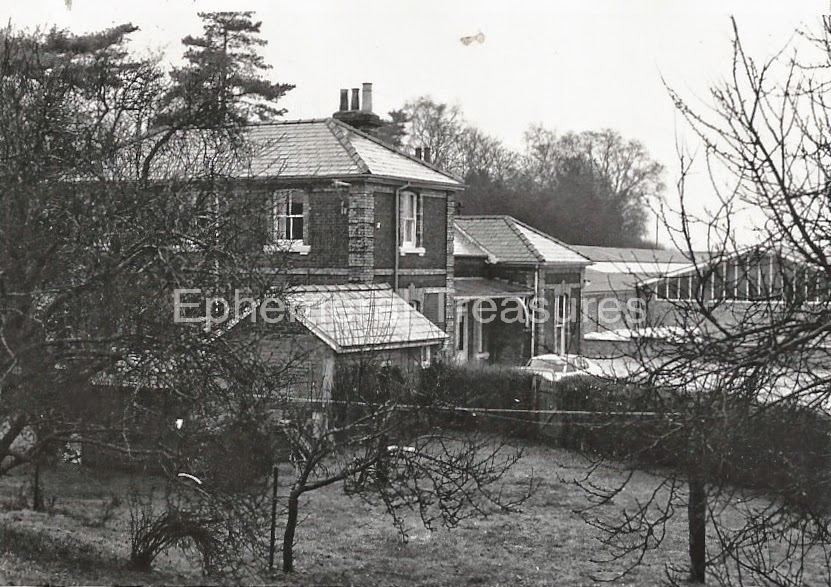
Below are some screen shots I took from google streetview in Feb 2013.

They show factory units on the site where The Station was, and look quite similar to how I remember it…


On Ebay there was this listing:
Disused Railway Station at Lavenham, Suffolk.
May 1973 Photograph, showing the disused railway station at Lavenham, Suffolk, with factories to the rear.
The station passed into disuse in 1965.


As you can see, they are copyrighted to a company named “Ephemeral Treasures”.


Aerosols / Stores...

In the aerosol factory, (which I’m reminded was known as “The Station” as it used to be the train station before it got decommissioned in the 1960s), lighter fuel tins had been known to explode and shaving foam could get everywhere too. There was a huge old machine at the end of the line for sealing boxes, and it’d always be covered in glue and get stuck – so the fitter (Stephen) used to have to un-jam it.

Mr Pye was the manager and Jasper drove the fork lift truck.

Apparently there was a man called Bryan who was supervisor in aerosols, but I don’t recall him (maybe he was there before/after me).

I do not recall hearing the radio in there as the machinery made far too much noise.

We were allocated tasks for each day (loading the tins / putting in the valves / weighing / watching the water tank / putting caps on / packing / boxes) and we would try to swap with the other girls throughout the day (especially if you had a horrid job). I remember a few of the names of the other girls who I worked in there with: Annette, Cathy, Dawn, Martina, Violet & Joyce (Violet and Joyce were nearing retirement age). I think that we broke it down into 4 sections (start until morning break, after break til lunch, after lunch until afternoon break, after the break until home time.)

As well as the aerosol factory the building housed the soap machines and a warehouse. I remember that there was a lovely girl called Jackie who worked on soaps. She was a talented artist and used to bring in some of her wonderful pictures to show us.  Apparently the supervisor in the soap department was a man called Alf.

There was no canteen as such, but a room with a few tables and chairs and a hot drinks machine. If you wanted a hot dinner you would have to go down to the works canteen at Riverside Works – or go into the village.

As well as the aerosols and soaps, there was a large warehouse at The Station (aka The Stores).  A chap called Graham was the stores manager and old German guy called George Schuler was a floor supervisor/ manager. They wore white coats while the others had to wear the brown coats. I believe they shared a little office just outside the stores not far from where you clocked in.

Buses...


Buses were laid on by the factory owners and collected the workers from all of the surrounding towns and villages. Mine went from Sudbury via Long Melford, Bildeston and possibly Acton (the ‘scenic route’). If you didn’t get out of the factory fast enough at the end of the day the buses would leave without you! It was always a challenge to find the right bus in the car park as they were not always parked in the same place each day and they had no signs on to say where they were going.

One day I missed my bus home but remembered that the last public bus back to Sudbury would stop in the High Street approx 5.15pm. I ran all the way up the hill and just managed to catch it (luckily I had just enough spare change for the fare!)

As humans are generally creatures of habit, we always used to sit in the same seats every day. I hated getting up at Mad O’Clock in the morning and was always tired, so I liked to sit alone and grab an extra 30 minutes doze on the way to work. One day a new girl sat next to me – she was Australian with blonde hair (Jill?). For several weeks we’d sit together on the bus chatting, but I was getting increasingly tired without my naps, so one day I deliberately moved to the back of the bus so that when she got on she didn’t see me, and that’s where I continued to sit. She eventually saw me but made no attempt to sit next to me again and I’ve always regretted the fact that I didn’t simply admit to her that I was tired and needed some extra sleep, and I hope that she didn’t think that she’d said or done something wrong…

Products...


Talc
Soap
Meths
Gift Sets
Mascara
Aerosols
Shampoo
Superglue
Superdent
Nail Polish
Mouthwash
Bubble Bath
Eye Shadow
Lipstick / Lip Gloss
Nail Polish Remover
Baby Lotion / Oil / Shampoo

There is a mention of Holloways on this Woolworths Museum site… http://www.woolworthsmuseum.co.uk/lostdepts.htm

Sites...


E. R. Holloway produced products for the cosmetics industry. I recall that the factory was on 3 sites, The Mill, Riverside Works and the Aerosol Factory (a.k.a. ‘The Station’).

Looking at google streetview I remember that The Station was where Frogs Hall Rd, Lower Road and Preston Road meet. There are currently industrial units on the site although the bricks appear relatively new so I assume these are not the original buildings from E. R. Holloway Limited.

Lower Road is where the Riverside Works was situated. I believe that a lady called Helen Hollocks was manager/supervisor there.

I believe that plastic formings, bottles and caps were made at The Mill (located on google streetview as Prentice Street / Bakers Mill).

This map shows roughly where the 3 sites were: The Station (Frogs Hall Road), Riverside Works (Lower Road) and The Mill.

Friday, 28 March 2014

About...


Imagine June 1979, Anita Ward was singing ‘Ring my Bell’ and Maggie Thatcher had recently moved into Number 10. I’d almost finished my six months training as part of a ‘Youth Opportunities Programme’ at a local silk screen printing firm after leaving school with less than impressive exam results the previous year, and had popped into the local jobcentre to see what other work was available. Back then, you could pick a card off the wall with job details on it, hand it to the lady at the desk and she’d set up an interview for you. I spotted a factory job in Lavenham which paid more than I’d been getting on the ‘YOP’ scheme, plus they provided free transport, so I took the card to the desk and an interview was arranged. In those days, as long as you turned up and didn’t say or do anything particularly outrageous in the interview you were almost guaranteed to get the job – so that’s what happened…


This postcard shows Lavenham in the 1980s – just how I remember it…


If you have any additional stories, photos etc you'd like to share just email me